


A REVIEW OF COMPETE BY DAN ABRAHAMS AND HOW IT HAS AN UNCANNY PARALLEL WITH THE FILM MUSIC OF EMINEM IN LOSE YOURSELF AND 8 MILE…
TWO DIFFERENT MEDIUMS…
One explanation of how to stay in the zone and compete to the best of your ability.
In the music video – lose yourself, by Eminem is one example of how focusing on the moment you’re in, ignoring the crowd, and just getting down to do what you do – and ignoring what others are thinking is exactly what happens in the film 8 Mile.
The Rabbit character in the film has gone through a lot – and comes out blazing with what he does best. He simply RAPS from the heart. And, he gets his rewards.
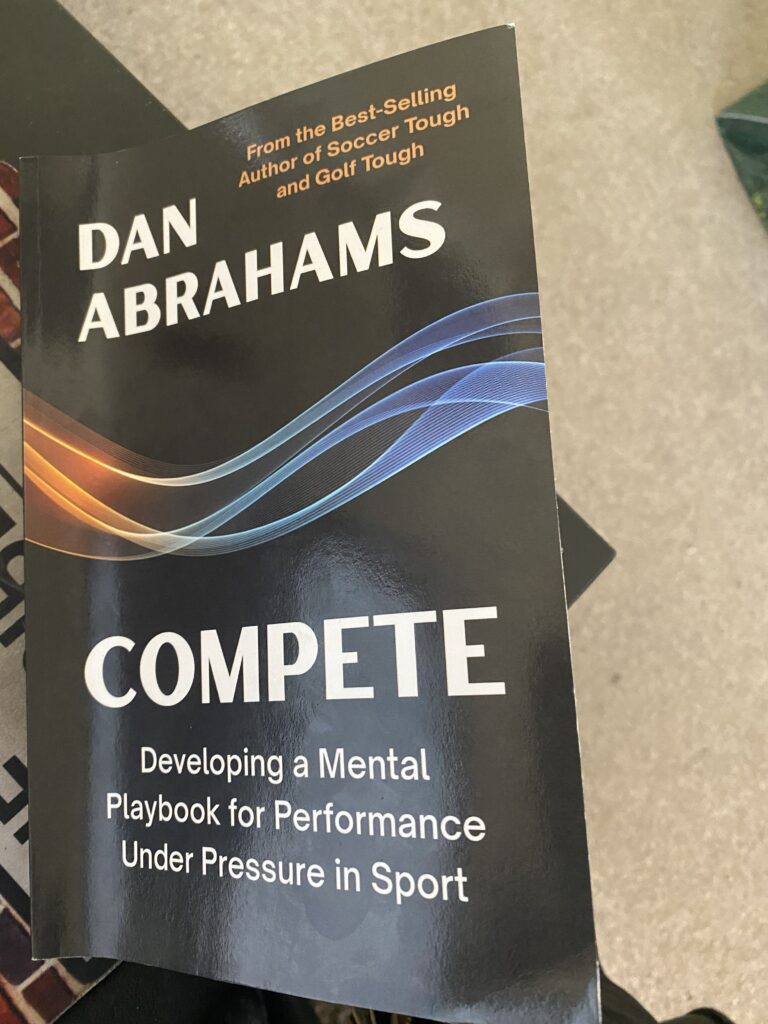
Now, another medium. In a book I was sent by Hawksmoor Publishing to review, Compete – by Dan Abrahams, there is a chapter where they talk about using your focus flashlight. Imagine there’s a flashlight on your forehead and it is observing everything!
There’s a quote in the book and it is from the account of the famous football manager Pep Guardiola on the obervations of Lionel Messi – and he writes regarding Messi’s uncanny ability to observe everything on the pitch, using the focus flashlight. He’s not running. He’s not aimlessly wandering, he’s using the torch to find out shift patterns in the game, and using every inch of the torch to find out how to get into the position to score goals and win.
Some call it the third eye…
The guardiola quote: “He’s (Messi) involved. He’s not out of the game. He’s continuously moving his head right and left. Right and left. His head is always moving. He’s not running. But he’s always watching what is happening. He’s looking for the weak points of the back four. After five or ten minutes, he has a map in his eyes and his brain – to know exactly where the space is and what’s the panorama. He knows “if” I move here or here – he will have more space to attack.”
Same could be said for snooker. Observe the table. Use your focus flashlight – quickly – and quietly to assess the situations – even when not playing a shot – focus on the table. The situations and the possible shots. In doubles, that’s quite good tactics – as well.
There’s a strange paradox in cue sports. The harder a player tries to control every detail, the more the game seems to slip through their fingers.
At some point, almost every league player has stood over a routine ball and felt the noise begin to build:
Don’t miss this. Stay down. What’s the score? What if I let the team down?
And suddenly the cue feels heavier than it did five minutes earlier.
That is why Lose Yourself has always resonated far beyond just a music track. Beneath the aggression and energy of the track sits a surprisingly sharp lesson about performance. The song is not really about confidence. It is about surrendering to the moment before overthinking destroys it. You own that moment. Do not miss your chance to blow, the opportunity only comes around once in a lifetime yo…
COMPETE MIRRORS LOSE YOURSELF WITH THE FOCUS FLASHLIGHT EXAMPLE: STAY FOCUSED. USE THE FLASHLIGHT…
In many ways, that idea mirrors the themes explored in Compete, a book which examines how high performers handle pressure, uncertainty and the internal battles that arrive when the stakes feel high. The central message is not that elite performers never feel fear or doubt. It is that they learn to perform alongside those feelings without allowing them to take control.
That lesson has played out repeatedly in recent matches for my Oxshott’s doubles campaign.
Playing alongside a younger teammate brought an unexpected layer of responsibility. The natural instinct was to think: If I let him down, I have failed. On paper, that sounds like the sort of mindset that should tighten a player up. Yet the opposite happened. Both stepped up and produced our best games at times it mattered.
With the pressure mounting in a recent doubles encounters, there came a moment where the simplest thing would have been to retreat into safety, caution and technical over-analysis. Instead, something shifted. The frames became clearer. The overthinking faded. The cue was trusted. The frames were won as a team. And we had the ability to play the frames out WITHOUT FEAR. Nerves are good. They show you care.
That experience revealed something important about amateur snooker and perhaps sport itself. Many players spend years searching for technical perfection when, in reality, their greatest opponent is often internal interference and often just the decision to play the game – and forget the mechanics or every nuance.
We as players sometimes spend too often thinking about perfection, and not just progress and playing the game. I believe some in the pro ranks have said this as well. Well, it’s been documented in mediums and by a Mental Coach, Abrahams, who’s written other books like Soccer Tough and Golf Tough.
The modern player can drown in information like:
- Keep still,
- Stay down,
- Pause at the cue ball,
- Watch the elbow,
- Feather correctly.
- Stand like this
- Watch this
- Watch that –
- Pause on the Backswing
All good and useful advice — until the brain tries to process all of it during the shot itself.
And then when the information overload drains the player, they start to get doubts and fears and start to wonder what’s wrong with their technique.
The irony is that some of the best snooker appears when a player’s back is against the wall. Under pressure, the brain suddenly simplifies everything. There is no room left for endless self-commentary. Decisions become instinctive. Commitment replaces hesitation. If you focus on just one thing, and do it well, and just LOSE YOURSELF in the moment, sometimes, you can get more success than you know.
That does not mean tactics and technique disappear. Far from it.
In recent Oxshott matches, there were frames shaped not by heavy scoring but by tactical adaptation — using the baulk cushion intelligently, forcing opponents into awkward escapes and attempting to control the rhythm of the frame rather than dominate through break-building alone. Sometimes those tactical decisions worked perfectly. Sometimes opponents escaped brilliantly from trouble.
But that is not failure. That is sport.
Too many players judge themselves entirely on outcomes. A good tactical shot can still be countered by a better escape. A strong safety exchange can still end with an opponent producing a telling clearance. The key difference lies in understanding whether the correct decision was made at the time.
That distinction matters.
There is a type of player in league snooker who may never compile the biggest breaks in the room but quietly influences matches through discipline, tactical awareness and composure. They are the frame organizers/winners — players who adapt, steady the team and keep frames alive long enough for pressure to shift elsewhere.
Those qualities are often undervalued because they do not always produce highlight-reel moments. Yet in team snooker they can be priceless.
Although, there are plenty of highlight reel type moments I have had in the doubles and the league with teammates.
Perhaps that is why 8 Mile continues to connect with competitors years after its release. The film’s defining moments are not really about music battles. They are about learning to stop fighting yourself.
Every snooker player knows the feeling of standing over a ball while carrying the weight of previous misses, league tables, expectations and self-doubt. The challenge is not eliminating those thoughts entirely. It is refusing to let them dominate the next shot.
I enjoy the pressure. Sometimes, it happens, sometimes it doesn’t. It doesn’t matter either way because the game is sport and sometimes you win, sometimes you lose.
The best frames often arrive when players finally stop trying to manufacture perfection and simply commit to the moment in front of them.
Sometimes the answer is not to think more.
Sometimes it is simply to lose yourself.
Rate Your Game
Score six key areas of your game, receive a simple improvement plan, then search for a coach near you.
Rate each part of your game
Your SnookerZone profile
—
—
Your suggested improvement plan
This is a self-assessment tool, not a formal playing standard or coaching diagnosis.
Recommend a coach in your area
Search by town, county or postcode area. Use the filters to narrow the results.
🎱 Before You Leave The Table...
📖 Final Frame Flavours
The original SnookerZone cookbook combining comfort food with cue sports.
View🎱 Enjoyed This Article?
Got a snooker story, recipe idea, collaboration enquiry, or simply want to say hello?