
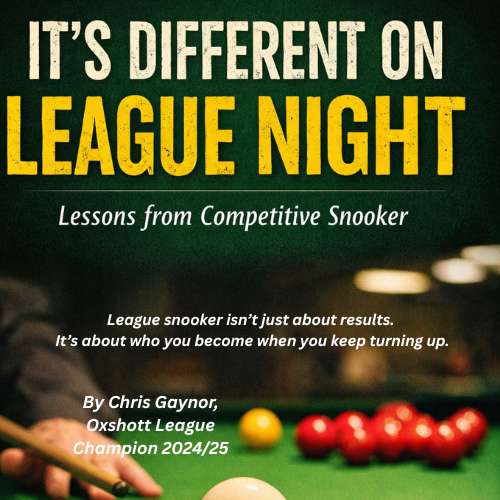
The first time I broke off at a snooker club in Surbiton in 2024, playing my first league match for Oxshott A in the Oxshott League, I knew instantly that I was hooked.
Before a ball had even been potted, I could feel it.
The room was quieter than a casual knock with friends. The air felt heavier. My opponent stood still, watching. My teammates were dotted around the table. I chalked up, placed the white, and suddenly my heartbeat seemed louder than the click of the balls.
It was just a break-off.
But it wasn’t just a break-off.
I’d played hundreds of frames before that night. You sometimes laugh off silly shots and rack up again without a second thought. With mates, the game is light. You experiment. You take on shots you shouldn’t. You don’t really care if you lose 3–0.
League snooker is different.
The moment that first break-off leaves your cue in competition, the game changes. It becomes something that carries importance. You’re not just playing for yourself anymore. There’s a result attached. A team. A small but undeniable sense of pride.
And that’s when many players feel the shock.
Why am I so nervous? Even now the nerves jangle after two seasons. But even now I still love the buzz of breaking off on a league night and pitting my wits against myself, as well as the opponent and the balls.
Why do I care this much? It’s OK to feel emotions. It’s part of being a human being and not a robot.
Why does missing suddenly feel uncomfortable? Because there is something riding on it.
Because competition tests you but it also improves you. Some will stay – and some will go.
When you miss in a friendly frame, you shrug. When you miss in a league match, you sit down and your mind starts racing. Is he going to clear up? Have I cost the frame? In some cases, the mindset shifts are important. Don’t think of a loss as a loss but as a growth lesson. What did I do that worked well? What do I need to work on for next time the balls clunk on the break off.
It’s amazing how quickly the internal pressure ramps up.
Some players try league snooker and decide it’s not for them. They don’t enjoy the nerves. They don’t like the idea of being beaten regularly – you win some and you lose some. They prefer the freedom of social play, where the stakes are low and the mood stays light.
There’s nothing wrong with that.
But the players who stay feel something else underneath the nerves.
They feel the buzz. The bolt.
That buzz from the first break-off on a Tuesday night. The handshake before the frame. The silence before impact. The knowledge that what happens next matters, even if only in a small corner of the world.
Over two seasons, I’ve come to realise that this feeling becomes addictive. Not the winning, necessarily. Not even the scoreboard. It’s the test.
League snooker forces you to test with yourself.
You learn how you react under pressure.
You discover how you handle disappointment. The emotional maturity of accepting that you’re not going to get the result every time.
You see how your focus shifts when the frame is tight.
Lose on the colours, a few weeks in a row and you begin to question your rhythm. Then one night you settle, pot a long blue under pressure, follow it with a pink, and you feel that surge of satisfaction that only competition can provide.
The result matters in the moment, of course. Nobody turns up wanting to not get a result. But over time, something deeper starts to form. The quiet acceptance that you will not always get the results.
You realise that the real value of league snooker isn’t in the league table. It’s in the character it quietly builds. Players will know what I’m talking about – know the feeling.
Turning up after a tough defeat.
Breaking off again when your confidence is slightly dented.
Shaking hands whether you’ve won comfortably or lost on the black.
That repetition shapes you.
You start to understand that losing isn’t a verdict on who you are. It’s information. It’s feedback. It’s part of the rhythm of competitive league sport. Form comes in waves. Confidence fluctuates. But resilience grows if you keep showing up.
You can’t control the flukes. You can’t control the lucky rubs of the green. But you can control your emotions.
That’s why the first break-off matters so much.
It’s not just the start of a frame. It’s the start of a mindset. You are stepping into something that will test you, however modest the stage may seem. And when you accept that test — when you decide to keep coming back regardless of the result — the game changes meaning.
Snooker stops being just fun frames down the club and into something a bit more serious. But, you can still enjoy the thrill of the frames, with the added pressure of the competitive edge. That’s why I love league snooker – you’re not just potting balls – your testing.
It becomes an example of how you deal with trials, tribulations, joys of potting a final black off the cushion, or the joy of winning a frame and getting the title.
Not everyone will want that. Some will try it once and drift back to casual frames. But those who stay discover that competitive snooker offers more than trophies or weekly scores. It offers structured pressure. It offers accountability. It offers growth.
And perhaps that’s why, from that very first break-off in Surbiton, I knew I was hooked.
Not because I expected to win every week – I knew I wouldn’t and that’s OK. Because most people won’t win every week. Even the top players won’t.
But because I sensed that this version of the game — heavier, sharper, more demanding — was going to make me stronger.
Not just on the table.
But off it too.
And that is more powerful than lifting any trophy.
I’ve suffered setbacks (traumas) off the table ones that are so much bigger than just losing a couple of frames here and there.
Which is why I don’t care about winning or losing. I care about growing. I love the competitive buzz. The first break off gives you that bolt. It feels good when you see the cue ball come back to baulk.
But I came back. And that’s a win for me. And either way – I am a winner on all fronts.
Some newbies who come to play league snooker will soon realise very quickly week by week what I have described.
They’ll play their first match, and want to come back many more times – not just to try and win, but to do better each time.
Snooker is the winner the more that come and play – and stay…