

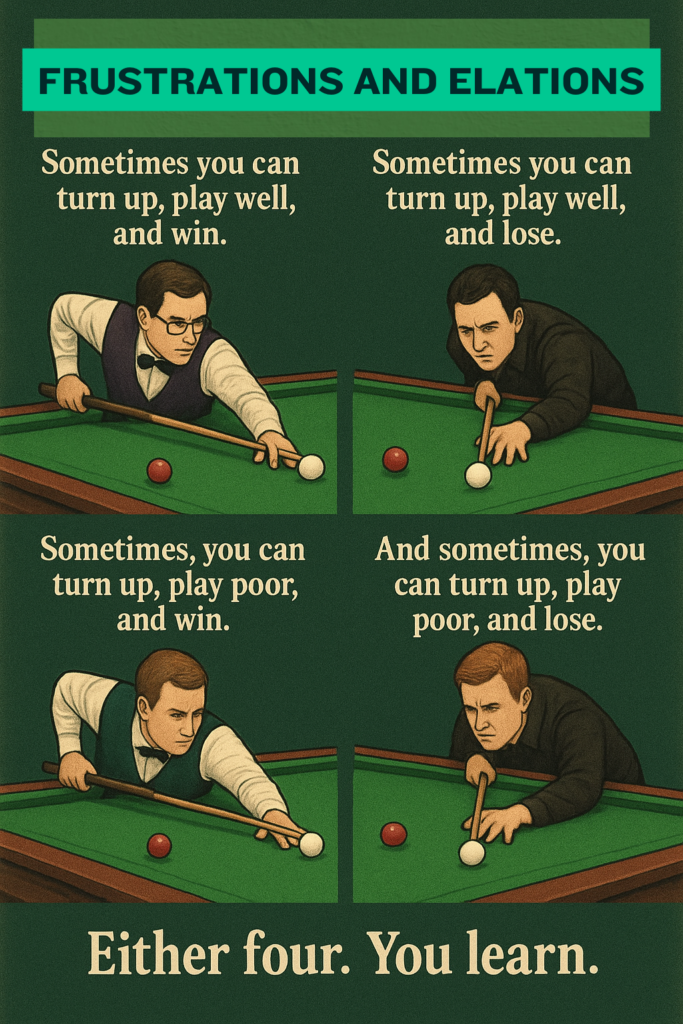
Pride of Performance: Why Good or Bad Nights Don’t Define Your Snooker…Nor the Scoreboard…
Lessons from the League — Why trusting your fundamentals, accepting fluctuations in form and enjoying the game can be more valuable than obsessing over results.
There is a temptation in snooker, particularly at amateur level, to judge everything by the scoreboard.
Win a frame and you’re playing well. Lose a frame and suddenly there must be something wrong with your technique, your mindset or your entire approach to the game.
But is it really that simple? No.
I’ve been reflecting on this following two very different competitive experiences at my club, Oxshott.
One was a doubles final in which my performance wasn’t quite where I wanted it to be. The other was a recent league match in which I played considerably better, won one of my two frames and produced a difficult black to secure victory.
The contrast reinforced something I’ve been learning for some time.
Form comes and goes. Your fundamentals don’t have to go with it.
When Your Game Isn’t There
In the doubles final, I experienced nerves (it was my first “final” outside of the normal league matches, and struggled to find the consistency I wanted.
I played some good shots, including a few long pots, but overall my game wasn’t flowing as naturally as I would have liked.
And that’s snooker.
Sometimes you arrive at the table and everything feels comfortable. Your cue action is smooth, your potting is confident and your decision-making seems straightforward.
On another evening, the same shots can feel more difficult.
The danger is what happens next.
Players can begin questioning everything.
Is my stance wrong? Has my cue action changed? Am I approaching the shot incorrectly? Is my confidence disappearing?
Before long, one disappointing performance becomes a reason to dismantle a technique that may have taken months or years to develop.
But a poor performance doesn’t automatically mean you have a poor technique.
It may simply mean you haven’t played particularly well that evening.
There is a difference.
The Black That Reminded Me Why the Basics Matter
During my recent league match, I faced a difficult black to win the opening frame.
The cue ball was tight against the cushion, making the shot particularly awkward.
These are the situations in which it’s tempting to become preoccupied with the outcome.
You know what’s at stake. You know that potting the black will win the frame. And you know that one poor delivery could cost you the opportunity.
But instead of thinking about everything that might go wrong, I trusted the fundamentals I’ve been practising.
Keep the head still.
Pause.
Deliver the cue smoothly.
Stay down on the shot.
I potted the black and won the frame.
It was satisfying, not simply because I’d won, but because I’d executed a difficult shot using the technique I’ve worked hard to develop.
The pressure hadn’t changed what I needed to do. It had simply made doing it more important.
That is one of the reasons we practise the basics.
Not just to perform them comfortably on the practice table, but to give ourselves a reliable routine when the pressure arrives.
Of course, following a good routine doesn’t guarantee that every difficult black will disappear into the pocket.
But it gives us a sound foundation from which to play the shot.
Sometimes Your Opponent Simply Plays Better
I lost the second frame that evening.
But here’s the interesting part: I didn’t necessarily lose because I was making poor decisions or abandoning my game.
I continued playing sensible shots. I put my opponent in a couple of difficult snookers and tried to make life awkward for him.
I also had a couple of opportunities I might have taken.
But towards the end of the frame, my opponent played slightly better.
And sometimes that’s the explanation.
Perhaps seeing me play well in the first frame encouraged him to raise his standard. I can’t know that for certain, but it’s quite possible.
What matters is that I didn’t need to interpret his improvement as evidence that my own game had collapsed.
A good safety shot doesn’t become a bad safety shot simply because your opponent produces an excellent escape.
Likewise, you can play a sensible attacking shot, execute it reasonably well and still see the frame go against you.
Snooker involves two players.
Your opponent has a say in the outcome.
That sounds obvious, but it’s surprisingly easy to forget when reviewing a defeat.
Form and Technique Are Not the Same Thing
One of the most useful distinctions an amateur player can make is between technique and form.
Technique is the collection of skills and habits you’ve developed through practice: your stance, alignment, cue delivery, timing and other fundamentals.
Form is how consistently you manage to reproduce those skills on a particular day.
Mindset influences how you respond when things are going well — and, perhaps more importantly, when they’re not.
These three things are connected, but they aren’t identical.
A player can possess sound technique and still experience a poor evening.
A player can also enjoy a particularly good evening without suddenly becoming technically superior to the player they were the previous week.
Form fluctuates.
That’s true at every level of sport.
And recognising that can prevent an enormous amount of unnecessary frustration.
There is certainly a place for technical analysis. If a particular problem keeps appearing, it’s worth examining it carefully, perhaps with a coach.
But changing your stance, grip or cue action after every disappointing match can create more uncertainty than it resolves.
Sometimes the best response to a poor evening is to acknowledge it, learn what you can and return to the table without carrying the disappointment into your next match.
Pride of Performance
This brings me to something I believe deserves greater emphasis in amateur snooker.
Pride of performance.
We naturally take pride in winning.
But what about the frame in which you played well and lost?
What about the excellent safety shot that forced your opponent into a difficult escape?
What about the long pot you executed under pressure, even though you eventually lost the frame?
Those moments still count.
The scoreboard tells us who won.
It doesn’t tell us everything about how either player performed.
In my recent league match, I won one frame and lost the other.
Yet I came away satisfied with my overall performance.
I had trusted my basics, made sensible decisions, played some good tactical snooker and produced a difficult winning black.
There were things I could have done better.
There always are.
But there was no reason to question everything I’d worked on simply because I hadn’t won both frames.
You can recognise your mistakes without allowing them to overshadow everything you did well.
That’s not complacency.
It’s balanced self-assessment.
Three Medals — And I Don’t Have to Prove I can Compete…
That same evening, I collected my runners-up medal from the doubles competition.
I now have three medals from my competitive snooker experiences.
Each represents time spent practising, competing, learning and putting myself in situations where the outcome wasn’t guaranteed.
The doubles competition itself began almost casually.
I hadn’t planned to enter. My partner asked whether I’d like to play, and I thought, why not?
We reached the final.
Looking back, that’s an achievement worth appreciating, regardless of how I felt I performed on the day.
And those experiences have helped me reach a different perspective on competition.
I don’t need to prove to somebody every week that I’m capable of playing snooker.
I’ve already demonstrated that I can compete, reach finals and win frames.
That doesn’t mean I expect to win every match.
It doesn’t mean I’ve mastered the game.
And it certainly doesn’t mean there’s nothing left to learn.
It simply means I can approach my next match without feeling that my ability is up for debate.
I can turn up, enjoy the game, trust my technique and see how the frames unfold. As far as I am concerned, it’s a WIN AND A LEARN.
There’s a big difference between confidence and expectation.
Confidence comes from knowing you’ve put in the work.
Expectation can become the burden of believing that, because you played well last week, you must produce the same performance again.
I’d rather carry the confidence and leave the expectation behind.
Five Coaching Lessons for Amateur Players
Here are five principles I’ve taken from these recent experiences.
1. Don’t rebuild your technique after one poor performance
A disappointing match doesn’t necessarily reveal a fundamental problem.
Look for recurring patterns before making significant technical changes. Sometimes, it simply just is a case of a bad day at the office…
2. Trust the basics when the pressure arrives
Your stance, stillness, pause and cue delivery are just as important on the winning black as they are during practice.
Pressure is not a reason to abandon your routine.
3. Give your opponent credit
Sometimes you lose because the other player produces better snooker on the day.
That doesn’t automatically mean your shot selection or performance was poor. Far from it. It just means you weren’t quite there on that day.
4. Review the performance, not just the result
Ask yourself whether you made sensible decisions, maintained your technique and responded constructively to difficult situations.
The score is one piece of information, not the entire assessment.
5. Enjoy the game you’re working so hard to improve
It’s easy to become so focused on results that we forget why we started playing.
Enjoy the challenge, the good shots, the tactical exchanges and the opportunity to learn.
Winning is rewarding.
But enjoyment shouldn’t depend entirely on winning.
A Simple Post-Match Reflection
After your next league match, try asking yourself five questions:
- Did I trust my fundamentals, particularly under pressure?
- Did I generally make sensible shot selections?
- How did I respond when my form wasn’t there?
- What did I do particularly well, regardless of the result?
- What’s one thing I can take into my next practice session?
You don’t need a lengthy technical report after every frame.
Sometimes a few minutes of thoughtful reflection are enough.
And if you played well but lost to a stronger performance from your opponent, acknowledge that too.
Not every defeat needs a technical explanation.
Trust What You’ve Built — And Just Play
The doubles final and my recent league for 2026/7 match produced different experiences.
In one, my form wasn’t where I wanted it to be.
In the other, I played well and executed a difficult winning shot.
But the underlying approach remained the same.
Trust the fundamentals.
Stay patient.
Stay involved.
Don’t panic.
Enjoy playing.
There will be more good nights. There will undoubtedly be more difficult ones.
That’s the nature of snooker.
What matters is not allowing every fluctuation in form to become a crisis of confidence.
You can take pride in your achievements without becoming complacent. You can learn from defeats without becoming disheartened. And you can enjoy victories without expecting to reproduce them every time you pick up a cue.
Above all, remember something I’ve come to believe more strongly through my league experiences:
The scoreboard doesn’t get to decide how I perform.
It records the result.
The quality of my performance is something I have to assess more thoughtfully.
And after all the hours spent practising, perhaps the most useful advice I can offer another amateur player is also the simplest:
Trust what you’ve built. Turn up. Enjoy the game. And just play.
Enjoyment Is a Victory in Itself
I never want to lose the enjoyment of playing snooker, regardless of what the scoreboard says.
Of course, I want to win. I want to play well, pot difficult balls and make good tactical decisions. But I don’t want the result to determine whether I’ve enjoyed my evening.
Nine times out of ten, I come away from the table having enjoyed myself.
And if I’ve enjoyed the experience, then, in my book, I’ve already won something.
That doesn’t mean ignoring mistakes or pretending defeats don’t matter. It means recognising that snooker offers much more than a final score.
There’s the challenge, the concentration, the camaraderie, the satisfaction of a well-executed shot and the opportunity to learn something new.
Those things remain valuable whether you win or lose.
I play to compete, I practise to improve, but I return because I enjoy it. Learn that philosophy and you’ll enjoy it too. That’s why after every frame, I always say, “I enjoyed that”…
Rate Your Game
Score six key areas of your game, receive a simple improvement plan, then search for a coach near you.
Rate each part of your game
Your SnookerZone profile
—
—
Your suggested improvement plan
This is a self-assessment tool, not a formal playing standard or coaching diagnosis.
Recommend a coach in your area
Search by town, county or postcode area. Use the filters to narrow the results.
🎱 Before You Leave The Table...
📖 Final Frame Flavours
The original SnookerZone cookbook combining comfort food with cue sports.
View🎱 Enjoyed This Article?
Got a snooker story, recipe idea, collaboration enquiry, or simply want to say hello?