


Lessons from the League: The Scoreboard Doesn’t Decide How I Perform
How reaching an Oxshott doubles final taught me about pressure, belief, the importance of basics and why there’s always something to learn — whether you win or lose.
By Chris Gaynor | SnookerZone.co.uk
It All Started With Two Words: Why Not?
Sometimes, the most rewarding experiences in snooker or in life are the ones you never planned.
I wasn’t originally intending to enter the doubles competition at Oxshott Club. In fact, it wasn’t really on my radar until a fellow club player asked whether I’d like to partner him.
I said, “Why not?”
There were no grand expectations. No predictions about winning trophies or reaching finals. We might have been knocked out in the first round. That’s snooker. You never quite know how you’re going to play on any given evening.
My attitude was simple: let’s have a bit of fun, play some snooker and see where it takes us.
As it turned out, it took us all the way to the final.
And that, for me, was a tremendous bonus.
But perhaps the most valuable part of the experience wasn’t reaching the final itself. It was what the journey taught me about playing under pressure.
When the Stakes Start to Rise
Something interesting happened as we progressed through the competition.
In the earlier rounds, the atmosphere felt relatively relaxed. We were enjoying ourselves, playing our matches and taking things as they came.
But by the semi-final, and certainly the final, the mindset had changed.
Suddenly, there was something tangible at stake.
We weren’t simply playing another match. We had an opportunity to reach a final, and then an opportunity to win one.
I noticed the difference.
The nerves were much more pronounced, particularly in the final.
There’s also an additional psychological dimension to doubles snooker. You’re not just playing for yourself. You have a partner alongside you, and naturally, you don’t want to let him down.
A missed pot, an unsuccessful safety or a positional error can feel more significant because somebody else is sharing the consequences.
I was very nervous.
But here’s the important point.
I didn’t allow those nerves to change the way I approached my snooker.
When Your Game Isn’t There
I’ll be the first to admit that my best form wasn’t there on the night.
There were spells when things weren’t quite happening. Shots I expected to execute didn’t always come off.
Yet, in patches, I played some good snooker.
I potted some good long balls and made what I believed were the right tactical decisions at important moments.
Not every shot worked.
But I’ve learned that there’s a difference between selecting the wrong shot and selecting the right shot without executing it as intended.
That’s a distinction worth understanding.
A good tactical decision doesn’t automatically become a poor one because the outcome was unsuccessful.
Of course, execution matters. If you’re repeatedly missing a particular shot or failing to control the cue ball, that’s something to examine and practise.
But it doesn’t necessarily mean your thinking was wrong.
And throughout the final, I kept returning to something I’ve learned through years of coaching and practice.
Basics will always win.
Not necessarily the match. But the battle to maintain your technique when the pressure increases.
The Basics Never Change
I’ve become increasingly interested in karate, and one of the things that has struck me about the martial art is the emphasis on repeating fundamental movements.
A beginner learns the basics.
An experienced practitioner continues practising those same basics.
Greater experience doesn’t make the fundamentals irrelevant. It makes their consistent execution even more important.
I see a strong parallel with snooker.
Whether you’re practising alone, playing a friendly frame or competing in a final, the fundamental principles of delivering a cue haven’t suddenly changed.
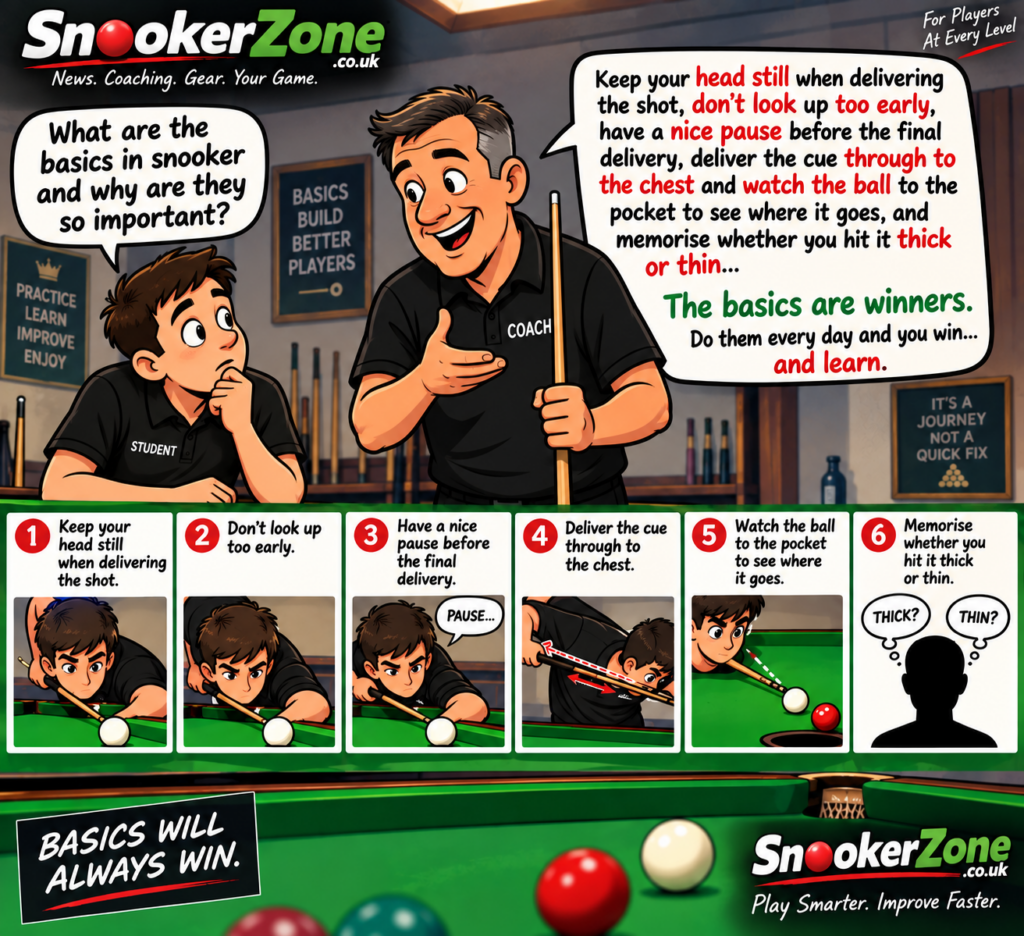
For me, the important reminders are straightforward:
- Keep the head still. Avoid unnecessary movement during the delivery of the cue.
- Pause before delivery. Give yourself the opportunity to settle before committing to the shot.
- Deliver the cue smoothly through towards the chest. Trust the cue action you’ve practised rather than forcing the shot.
- Stay down and observe the result. Watch the object ball travel towards the pocket without prematurely lifting your head.
These aren’t complicated ideas.
But when you’re nervous, executing simple things consistently can become surprisingly challenging.
During the doubles final, I tried to keep trusting those basics.
And when I potted some of my better long balls, I wasn’t doing anything extraordinary.
I was simply trying to deliver the cue correctly.
That’s an important lesson.
You don’t need to invent a new technique because you’re playing in a final. You need to trust the technique that got you there.
The Scoreboard Doesn’t Get to Decide How I Perform
One of my most important coaching principles is:
“The scoreboard doesn’t get to decide how I perform.”
Having now experienced two finals, I believe in that statement more than ever.
The scoreboard tells us who won and who lost.
It doesn’t tell us how nervous a player felt.
It doesn’t reveal whether somebody maintained a smooth cue action, selected sensible shots, resisted the temptation to panic or recovered their concentration after a mistake.
Those technical and mental aspects of performance aren’t reflected adequately in the final score.
You can win a match while playing below your usual standard.
You can also lose a match while doing many things correctly.
That’s why I believe players should be careful about allowing results alone to define the quality of their performance.
Of course, I wanted to win the doubles final.
But the result didn’t determine whether I could keep my head still, pause before delivery or commit to a sensible shot.
Those were things I could continue trying to control, regardless of what was happening on the scoreboard.
And that’s where the real value of the philosophy lies.
Nervous Doesn’t Have to Mean Playing Nervously
There’s another distinction I took from the final.
I was nervous, but I didn’t abandon my usual approach.
I continued trying to play the same basics, even when my form wasn’t particularly good.
That’s not to say the nerves had no effect whatsoever. Competitive pressure can influence timing, touch and concentration in subtle ways.
But I didn’t consciously change my technique or start playing recklessly because the occasion was important.
I tried to ride through the difficult periods.
And I think that’s something amateur players can learn from.
The objective isn’t necessarily to eliminate nerves.
The objective is to prevent them from dictating your decisions.
You can feel nervous and still select the correct safety.
You can feel nervous and still pause before delivering the cue.
You can feel nervous and still pot a difficult long ball.
Confidence isn’t always about feeling comfortable. Sometimes it’s about trusting yourself to perform while feeling uncomfortable.
Winning Doesn’t Mean There’s Nothing Left to Learn
I’ve always believed that every match offers an opportunity to learn.
And that includes the matches you win.
Sometimes players win and think they’ve done everything correctly.
But winning can disguise technical weaknesses, poor shot selection or moments of questionable judgement.
Equally, losing can reveal strengths that might otherwise go unnoticed.
I’d rather come away from a final having learned something useful than become so preoccupied with the result that I overlook the performance itself.
Ideally, of course, you win and learn.
But the learning shouldn’t stop because you’ve collected a trophy.
After a match, I think every player could benefit from asking three straightforward questions:
- What did I do well?
- What could I have done better?
- What will I take into my next match?
For my doubles final, I could identify several positives.
I made sensible tactical decisions in patches. I potted some good long balls. I largely maintained my technical basics, despite being nervous.
There were also areas to improve, particularly consistency when my game wasn’t flowing.
That gives me something practical to work on.
And that’s far more useful than simply saying, “We lost.”
A Simple Coaching Exercise: How Did I Really Perform?
One idea I’ve been developing for SnookerZone is a series of short coaching reflection cards.
Rather than asking players to complete a lengthy questionnaire, the aim would be to encourage them to think about a few important aspects of their performance.
For example, after a competitive match, a player might ask:
Technical basics
- Did I keep my head still?
- Did I pause before delivery?
- Did I deliver the cue smoothly?
- Did I stay down and observe the shot?
Mental performance
- Was I nervous?
- Did my nerves change my approach?
- Did I remain patient when my form disappeared?
- Did I regain focus after mistakes?
Match awareness
- Did I generally select the right shots?
- When a shot failed, was the problem the decision or the execution?
- What did I do particularly well?
- What’s the one thing I want to improve next time?
The objective isn’t to produce a perfect score.
It’s to develop awareness.
A player who understands why a shot succeeded or failed has something useful to take into the next practice session.
That’s coaching in its simplest form.
Don’t Let Success Become Another Form of Pressure
There’s a final part of this story that I find particularly encouraging.
After the doubles final, my partner asked whether I’d like to enter the competition with him again this season.
I said yes.
Once again, there are no expectations that we’ll reach another final.
We might go out in the first round.
We might progress through several rounds.
Who knows?
But something has changed since the first time he asked me to partner him.
Back then, my attitude was simply, “Why not?”
Now it’s:
“Why not? We know we can give people a game.”
That’s not arrogance.
It’s belief built on experience.
We’ve demonstrated that we can compete and reach a final. Nobody can take that achievement away from us.
And I don’t think we should be underestimated.
But equally, we shouldn’t assume we’re entitled to repeat what happened.
There’s an important difference between confidence and expectation.
Experience should build belief, not burden you with expectation.
The first final is now in the memory bank.
Whatever happens next season, we’ve already achieved something together.
And that makes entering again an opportunity to enjoy another experience, rather than an obligation to reproduce the last one.
My Advice to Anyone Starting Snooker
If I could offer one piece of advice to somebody beginning their snooker journey, it would be this:
Get the basics right. Repeat them. Then go and enjoy a frame of snooker.
Don’t become obsessed with tournaments, trophies or how well you might perform in competitive matches.
Learn how to stand correctly.
Learn how to form a good bridge.
Learn how to deliver the cue smoothly.
Learn to keep your head still.
Practise those fundamentals regularly, and gradually apply them in frames against other players.
You don’t need to wait until your technique is perfect before enjoying the game.
And don’t underestimate the satisfaction of simply striking a cue ball properly.
That’s where the enjoyment begins.
The principles I’ve observed in karate reinforce that belief.
The basics don’t suddenly change because somebody becomes more experienced.
You simply develop a deeper understanding of them.
And if you eventually find yourself playing in a final, those same fundamentals will still be there for you.
Enjoy. Learn. And You Win Regardless.
We didn’t win the Oxshott doubles final.
But I enjoyed the experience enormously.
I learned more about the pressure of playing in a final, the responsibility that comes with doubles, and the importance of trusting my technique when my form isn’t there.
I also strengthened my belief that I can compete in these occasions.
And perhaps that’s the biggest takeaway.
I wasn’t even intending to enter the competition in the first place.
A colleague asked me to partner him. I said yes. We reached the final.
Now we’re going to give it another go.
There are no guarantees, and there don’t need to be.
Because I’ve always believed in one simple philosophy:
Enjoy. Learn. And you win regardless.
The scoreboard records the result.
But it doesn’t get to decide how I perform.
And it certainly doesn’t get to decide what I learn from the experience.
SnookerZone — Lessons from the League
Basics will always win. Stay patient. Stay involved. Don’t panic.
Rate Your Game
Score six key areas of your game, receive a simple improvement plan, then search for a coach near you.
Rate each part of your game
Your SnookerZone profile
—
—
Your suggested improvement plan
This is a self-assessment tool, not a formal playing standard or coaching diagnosis.
Recommend a coach in your area
Search by town, county or postcode area. Use the filters to narrow the results.
🎱 Before You Leave The Table...
📖 Final Frame Flavours
The original SnookerZone cookbook combining comfort food with cue sports.
View🎱 Enjoyed This Article?
Got a snooker story, recipe idea, collaboration enquiry, or simply want to say hello?